31May

How to Ace a Job Interview in 2024 (+ Questions to Ask and Avoid)

Landing a job interview is rewarding, but the real challenge lies in impressing your interviewer and securing the offer. While an outstanding resume and cover letter are essential, they won’t save you if you make common interview mistakes. The key to acing your job interview is thorough preparation.

With some strategic job interview preparation, you can set yourself up for success by getting in the right mindset, reducing nervousness, and boosting your confidence. Here’s a detailed guide to help you cover all bases and shine in your next interview.

Research Your Interviewer and the Company

The first step in how to nail an interview is to research, research, research. Make sure you’re doing plenty of research on your interviewer and the company you’re applying for using sites like LinkedIn, Twitter, and Google.

It’s one of the top job interview tips, but most people only research the company itself. The problem is this might not give you all the information you need, especially if it’s a huge company. While it’s a good place to start, if you have the name of the interviewer, dig into their background a little as well. Get to know them before you get in a room with them.

The goal is NOT to stalk them or memorize everything they’ve ever done. Instead, it’s to learn:

  • Their background (What schools did they go to? What clubs have they been a part of?)
  • Their position with the company (Are they in a new role? Were they recently promoted?)
  • Common interests you both share (Are they into volunteer work, sports, hobbies, etc?)

With these details, you can spark deeper discussions and stand out by subtly bringing them up during the interview. This shows you’re someone who goes the extra mile, is proactive, and genuinely cares. The result? A great job offer.

Find the Question Behind the Question

When someone asks you, “Can you tell me a little about yourself?” it seems simple and very straightforward, but the reality is, “tell me about yourself” has dozens of questions behind the question.

A great way to uncover the question behind this question is to think:

  • What do they need to know about my background?
  • What would they be concerned about?
  • How will this answer reflect what type of worker I am?
  • Are they testing to see if you’ve done your research on the role?

Always take time to pause and think about what they want. If you jump into answering their question or try to sound good, you can miss what’s really being asked.

Remember, the interviewer isn’t interested in your dog’s name or your favorite flavor of ice cream. They want to know more about you as a professional. And the best way to do this successfully is to think of the answer before you step in the interview room.

Make some notes on potential answers, such as your educational background and how it led you to this industry. Add in some color when you describe this, mentioning the skills and experience you picked up along the way. Bonus points if you can describe a specific situation that made you want to pursue this field or train for a new role.

To recap, don’t just give a random answer, think about the question and:

  • Figure out the question behind the question
  • Write out a plain English answer
  • Polish your answer and give it some color

Once you’ve got that down, practice giving the answer in a mirror. Do it a few times, and work on making it seem less robotic and more conversational. It still needs to sound natural, especially when you’re talking about yourself.

To help you search for the true meaning behind the question, come up with a list of 10 potential job interview questions. Run them through the criteria above to uncover the hidden meaning behind what the interviewer could really be asking. This exercise will help you disassemble what questions are really asking and prepare you for when you sit in front of an interviewer.

Avoid Using Too Much Jargon

If we try too hard to sound smart and professional, we end up sounding like idiots: “Yes, the occupation filled me with immense joy as I interacted with my supervisor on a day-to-day basis to execute the financial…”

HUH?

A better strategy is to first translate what we’re trying to say into plain English. Then, if our response is compelling, we can polish the exact language to make the answer interview-worthy.

Imagine the interviewer asks “Why do you want this job?”

Before blurting out something about how you really “love their corporate values” or how you’re “so passionate” about the job, come up with something more realistic.

Here are some real reasons you might want to work at Company X:

  • The company does great work
  • There are a lot of smart people here
  • I think I can do a good job

So here’s what your answer might look like in plain English:

“I want to work here because the company does great work in the local tech community and I’d love to be a part of a growing industry.”

Tip: With the questions you deconstructed earlier, come up with your plain English responses. Be sure to also address the question behind the question.

Take some time to write these down. But don’t worry about sentence structure, finding the perfect words, or sounding smart. Just keep it simple and natural.

An answer in plain English is already better than most. Why? Because interviewers aren’t looking for a robot who can give a perfect, rehearsed answer. They want something genuine, an insight into your personality. They want to see how you explain complex issues and your approach to communication.

Remember, these are people you may have to work with every day. They want someone they can get along with, someone who is professional but also has a personality. The plain English answer shows that you’re not simply reading from a script or memorizing what the internet told you was a great answer. You’re explaining things in a simple way that people understand.

Another thing to think about is using jargon. Before jumping into a jargon-filled monologue about why you’d be the perfect hire, take a step back. The interviewer may or may not know what you’re talking about.

If it’s the first round of interviews, you may not be interviewed by someone from the department you’re applying for. It may be someone in recruitment or HR. If you start mentioning technical language they’re not familiar with, it could go over their heads.

A good rule of thumb is to listen to how the interviewer speaks. You can usually get a good idea of whether someone’s on the same page by their job title, the questions they ask, and whether they use jargon themselves.

For example, say you’re applying for a digital marketing role. If they mention things like AdWords, SEO, and bounce rate, you’re safe to use that same type of jargon.

Master Your Body Language

Your mouth may be moving and saying all the right things, but is your body saying something different?

Interviews are nerve-wracking experiences for most of us, and that can cause us to tense up. With hunched shoulders, crossed arms, and eyes on the floor, your body language can use some serious work.

There are tons of resources, studies, and books out there to help you master your body language, but here are some quick tips:

Show Your Palms: According to the authors of “Crazy Good Interviewing,” John B. Molidor, Ph.D., and Barbara Parus, showing your palms is a simple way to show sincerity. This gesture signals to the interviewer that you are honest and open.

Press Your Fingertips Together: This gesture makes your hands look like a church roof. It’s considered a way to show confidence, and you may recognize it from speeches that politicians, CEOs, or lecturers give. It’s also a good way to steady your hands if you’re nervous.

Don’t Conceal Your Hands: One thing to avoid is to conceal your hands. Putting your hands in your lap or beneath the table may feel most comfortable for you. But body language experts suggest that this unconsciously signals that you have something to hide. More likely, you’re just nervous, but we don’t want a hint of doubt in the interviewer’s mind. The same goes for if you place your hands downwards. Instead, keep your palms facing up to show you’re open and honest.

Speak with Enthusiasm

It’s not all about what you say; it’s about how you say it. Interviewers don’t want to hire someone who sounds bored to be there. They want someone who is enthusiastic and full of energy.

Being monotone can, at best, mean you don’t stand out, or at worst, put the interviewer off the idea of hiring you at all. Passion and enthusiasm help you stand out.

If you know your voice is a bit monotonous or nervous during interviews, spend some time practicing speaking. Stand in front of a mirror and practice answering questions. Maybe even record yourself doing it and play it back. Try repeating it with a higher inflection and more enthusiasm so it won’t feel as weird or fake when you come to do it for real.

Dress Slightly Better Than the Job You Want

It doesn’t matter where you’re interviewing, play it safe and dress slightly better than the job you want.

Lots of companies now have casually dressed employees. T-shirts and jeans are the new suit and tie in some places.

But does that mean you should whip out the old Levi’s for your interview? Probably not.

Figuring out the dress code can be a bit tricky. You may have to do some investigating or just straight up ask. Once you know the dress code, aim to dress slightly smarter than that.

You’re aiming to impress, not just with your words but also with a non-verbal first impression. Interviewers can already tell a lot about you as soon as you step through the door, so make that first impression a good one.

Use a Story Whenever You Can

A common style of interview question is the “tell us an example of when you handled X” or “tell us about a time you handled a challenging situation at work.”

Before blurting out a factually correct (yet boring) answer, take some notes from the novelists in the world. Show don’t tell is the number one rule in any kind of fiction writing. And you can apply that to interview questions as well.

Instead of telling the interviewer what you did, try to show it instead. Illustrate a more detailed picture of the situation, the challenge, the steps you took, and then the result. This works with any type of question the interviewer asks, including the dreaded “tell me about yourself” question.

A story, when told well, is the easiest way to deconstruct an answer and elevate yourself in the eyes of the interviewer.

Here’s what to say in an interview when you’re asked, “Why do you want to work here?”

  • Start with a Broad Opening: Set the stage with some high-level background to let the interviewer know what you’re going to talk about before diving into the details. For example: “I want to work at ACME Company for three key reasons. First, you’re doing amazing, life-changing work in the field of X. Second, I’m confident I can make a huge contribution, given my experience in Y. And third, you have some of the smartest people in the world working for you. That really excites me from an intellectual perspective.”
  • Get Really Specific: Now, transition into a short story with only the relevant details. For example: “Working with the smartest people is a big deal for me. You’ll notice that I have a history of actively seeking out and working with the top people in my field, such as John Smith and Jane Doe, who really pushed me to accomplish Z.”
  • Highlight the Important Takeaways: Lastly, get broad again and highlight the key takeaways. For example: “The bottom line, I thrive in environments filled with smart, ambitious people, and that’s why I’d love to be a part of the ACME team.”

Notice how different this is from what most people say in interviews. It’s crisp and concise with no fluff and packed with details that are engaging and impressive.

Filter your responses to common interview questions through this step-by-step system, and you’ll give the perfect answer every time.

Don’t Trash Talk Your Current Workplace

It should go without saying, but don’t trash talk. Anyone. If you’re asked why you left your previous job, you may be able to rant all day and all night. But resist the urge. It’s not a good look.

Honesty is the best policy in job interviews, but when answering the question “Why are you looking for another job?” it’s safer to give a more filtered answer.

The best way to spin it is to deflect and say something positive about the job you’re interviewing for and (if you can) say something positive about your current/previous role. You could phrase it like “I learned a lot in my current role, but I’m looking for a new challenge/the next step/a bigger team.”

This is a much more professional response that also highlights why you want this role, not just that you’re desperate to leave your current one.

Best Questions to Ask in a Job Interview

What are some of the biggest challenges with this job and what approaches have you used to tackle them?

Why this works: This question shows you’re familiar with the position’s demands and that you’ve done your homework. It signals to the interviewer that you’re ready to hit the ground running and won’t need extensive training.

I read online that you recently won the award for ‘Top Places to Work.’ What are some of the ways the company continues to set the bar in the industry?

Why this works: By asking this, you demonstrate that you’re up-to-date with the company’s achievements and genuinely interested in its future. It shows you’re not just applying randomly but are invested in the company’s success.

What metrics are most important to you when measuring the success of a candidate?

Why this works: This question provides you with key insights into what the interviewer values in a candidate. It allows you to tailor your responses to align with their expectations and demonstrate that you’re the ideal fit for the role.

Questions to Avoid Asking in a Job Interview

What’s the salary for this position?

Why this doesn’t work: Discussing salary upfront is a major turn-off for interviewers. It suggests you’re more interested in compensation than the role itself. Do your research beforehand and focus on the responsibilities and how you can contribute to the team.

What does your company do?

Why this doesn’t work: This question signals that you haven’t done your homework. It’s easily answered with a quick Google search, and asking it in an interview shows a lack of preparation and interest.

Not asking any questions

Why this doesn’t work: Failing to ask questions can make you appear disinterested or unengaged. Interviews are a two-way street, and asking insightful questions shows you’re serious about the role and the company.

Final Thoughts

Acing a job interview in 2024 requires more than just showing up and answering questions. It involves thorough preparation, understanding the deeper meaning behind questions, mastering your body language, and showing genuine enthusiasm for the role. By following these tips, you can make a lasting impression on your interviewer and significantly increase your chances of landing the job.


FAQs

How should I research a company before an interview? To research a company, start by exploring their official website, LinkedIn, and social media profiles. Look for recent news articles, press releases, and employee reviews on sites like Glassdoor. Understanding the company’s culture, values, and recent achievements can help you tailor your responses and show that you’re genuinely interested in the role.

What are some common interview questions to prepare for?

Common interview questions include:

  • “Tell me about yourself.”
  • “Why do you want to work here?”
  • “What are your strengths and weaknesses?”
  • “Describe a challenging situation and how you handled it.”
  • “Where do you see yourself in five years?”

Prepare thoughtful and concise answers for these questions, focusing on your experiences, skills, and how they align with the job requirements.

How can I improve my body language for an interview? Improving your body language involves practicing good posture, maintaining eye contact, and using open gestures. Avoid crossing your arms, fidgeting, or looking down. Practicing in front of a mirror or recording yourself can help you become more aware of your body language and make necessary adjustments.

Why is it important to ask questions in an interview? Asking questions in an interview shows that you’re engaged, interested, and proactive. It helps you gather important information about the role and the company, and demonstrates to the interviewer that you’re serious about the opportunity. It also allows you to assess if the company is the right fit for you.

What should I avoid saying in an interview? Avoid negative comments about your previous employers or colleagues, discussing salary or benefits too early, and giving overly rehearsed or vague answers. Focus on being positive, professional, and honest, while showcasing your skills and experiences.

How can I reduce nervousness before an interview? To reduce nervousness, practice your answers to common questions, research the company, and do mock interviews with a friend or family member. On the day of the interview, arrive early, take deep breaths, and remind yourself of your qualifications and the value you bring to the role.

31May

What Candidates Say They Want vs. What Their Actions Reveal

The concept of revealed preference, drawn from economics and marketing, can indeed provide valuable insights when applied to recruiting and employer branding. Here’s a breakdown of how this concept can be utilised effectively in these fields:

Understanding Revealed Preference in Recruiting

Revealed Preference: While people may articulate certain preferences, their actual choices often reveal their true priorities. For instance, in the context of recruiting, candidates might state they value work-life balance but consistently choose roles in companies known for their high compensation.

LinkedIn’s Data on Candidate Priorities

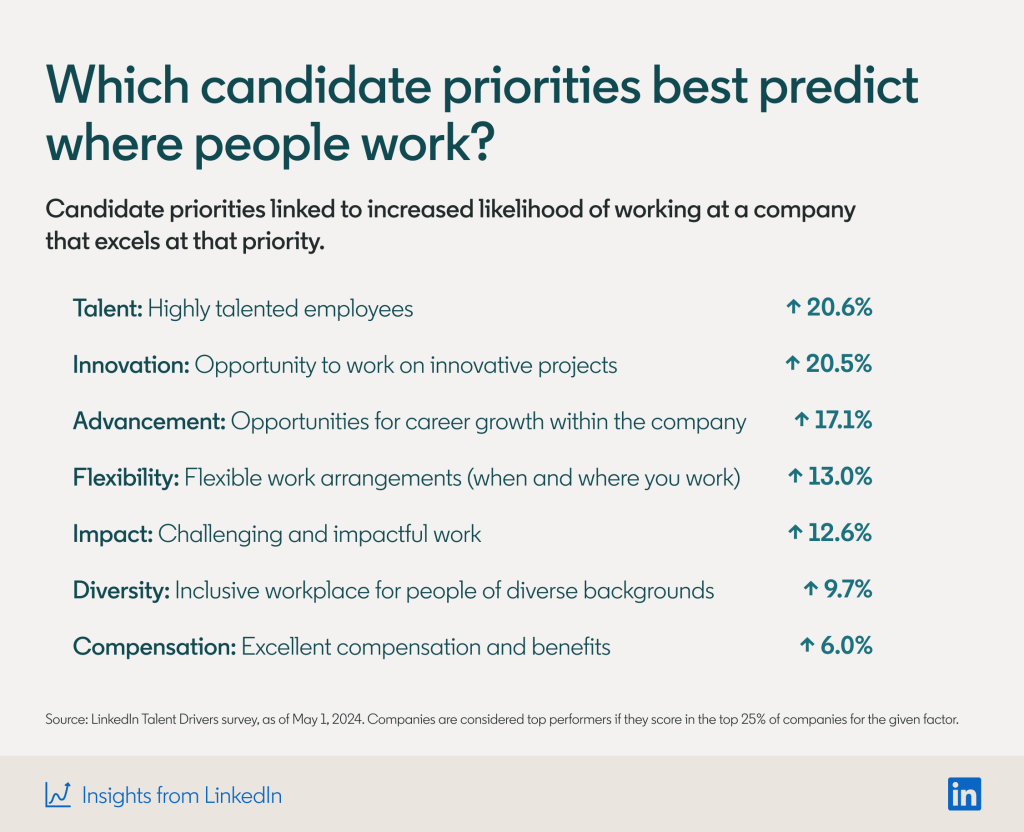
LinkedIn’s Talent Driver Survey: Every month, LinkedIn surveys thousands of members globally to understand their top priorities when considering a new employer. The survey data is then compared to where these members actually choose to work, providing a clear picture of revealed preferences.

Top Stated Priorities: According to LinkedIn’s survey of nearly 15,000 members in April 2024, the most frequently cited priorities are:

  • Compensation
  • Work-life balance
  • Flexibility

Other significant priorities include job security, opportunities for advancement, impactful work, and opportunities to learn new skills.

Aligning Employer Branding with Revealed Preferences

Analyzing Actions Over Words: To attract the right talent, companies need to focus not only on what candidates say they want but also on what their actions indicate they truly value. Here’s how some of the top stated priorities align with actual workplace choices:

  • Highly Talented Employees: Only 11% of members prioritise this, yet those who do are over 20% more likely to work at companies known for having highly talented employees.
  • Innovative Projects: Members who prioritize innovation are also over 20% more likely to work at companies recognized for innovation.
  • Opportunities to Advance: Gen Z candidates, in particular, value career advancement opportunities, and those who prioritize this are 17% more likely to work at companies offering clear paths to advancement.
  • Flexible Work Arrangements: Flexibility is a critical factor, with candidates prioritizing this being 13% more likely to work at companies known for flexibility.
  • Challenging and Impactful Work: Baby Boomers value this highly, and those who prioritize challenging work are 13% more likely to work at companies offering it.
  • Inclusive Workplace: Diversity may not be a top priority for many, but those who value it are 10% more likely to work at companies known for inclusion.
  • Compensation: Despite being the most common priority, those who prioritize compensation are only slightly (6%) more likely to work at top-paying companies, suggesting other factors are also influential.

Misalignments Between Stated and Revealed Preferences

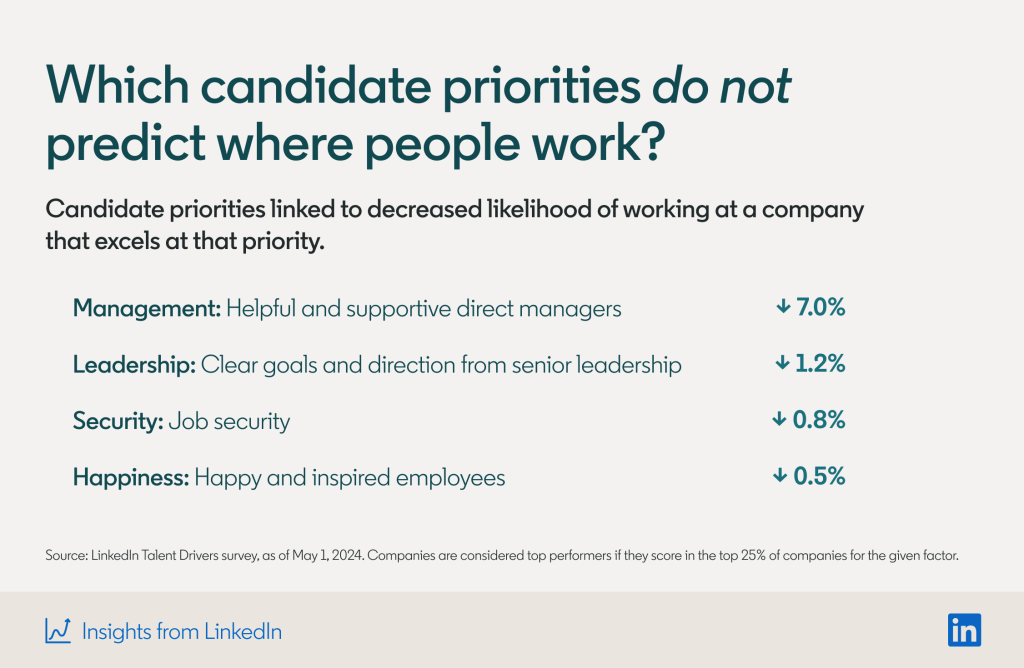
Negative Correlations: Some stated preferences do not align with where people end up working. For example:

  • Helpful Managers: Members who prioritize helpful managers are 7% less likely to work at companies known for good management, possibly due to the difficulty of assessing management quality during the hiring process.
  • Clear Leadership, Job Security, and Inspired Employees: These factors show a weaker correlation with actual job choices, indicating they may be less decisive in candidates’ career decisions.

Implications for Employer Branding

Strategic Alignment: By understanding and leveraging revealed preferences, companies can more effectively tailor their employer branding strategies. This approach ensures that branding efforts resonate with what truly matters to potential candidates, thus enhancing the ability to attract and retain top talent.

Actionable Insights:

  1. Highlight Flexibility: Emphasize flexible work arrangements in branding efforts.
  2. Showcase Innovation and Advancement Opportunities: Promote opportunities for innovation and career growth.
  3. Focus on Impactful Work and Inclusion: Highlight the challenging and inclusive nature of the work environment.
  4. Balance Compensation with Other Priorities: While compensation is crucial, ensure other appealing aspects of the workplace are also highlighted.

By focusing on these revealed preferences, companies can create a more compelling and authentic employer brand, ultimately leading to better talent acquisition and retention.

Source: Linkedin Talent Blog

27May

8 Ways to Show You Want the Job

So, you’ve reached the interview stage. Now how do you show that you really want the job?

No matter what stage you’re at in your career, it’s exciting and maybe even a little nerve-wracking to get to the interview stage for a role. Often, there can be a lot riding on the result. You could be trying to fulfill a lifelong aspiration, or it offers benefits that align really well with where you’re at right now with your life, or what you want your future to look like.

But you’re often not the only applicant for a role or the only person that they are going to be interviewing, so how do you show the interviewers that you’re not only the right person for the role but that you want it more than the others?

Demonstrate Self-Motivation

It’s all well and good to say you really want the job, but it can help you stand out if you can back it up with tangible reasons that demonstrate this. If you can prove your drive to be successful in the specific sector or role that you’re applying for, this can help the interviewers see that your enthusiasm goes beyond ‘just landing the job.’ Knowing the job description inside out and conveying knowledge of the sector that goes beyond what’s in the job ad can help.

Research and Share Knowledge

Before the interview, research as much as you can, not only about the company but the role itself and everything that it entails such as responsibilities, main objectives, long-term goals, and ways this role would typically help the company improve. You also need to research the industry that the business operates in – any deeper background knowledge of the sector will show that you’ve taken the initiative to learn and prove that you’re enthusiastic to be a part of it.

Go the Extra Mile

But before you get to the interview stage, there are things that can be done to show you really want the job at the initial application phase. While it’s time-consuming, if you’re really keen on a role, it can pay to go the extra mile. When writing your application, include a section after your cover letter to answer any specific criteria that the organization may have put on the job description. If they list things like experience in a similar role, good communication skills, experience working with external stakeholders, answer these directly so the hiring manager can immediately see these and define whether you might be a good fit. Taking this extra step can make it easier for the hiring manager and will leave an impression. If you’re going for something like a marketing or design role, provide links to past examples of your work, especially those that align directly with the job you’re applying for, which shows you’ve put thought into the application and that you’re a potential fit.

What You Can Contribute

Especially in the case of mid to senior-level roles, have key points prepared to deliver on how you can contribute to the company’s continued success. Relay how you think the organization could continue to evolve and how you can help with that by bringing up results and success in your previous work – ensure to include hard insights backed up by data and statistics to help support this.

Display Your Suitability Throughout

During the interview process, ensure you’re constantly reiterating your suitability for the role. It’s good to compliment a few of your answers with a demonstration of how your skills and experience apply to that particular line of questioning. For instance, “Tell me about your prior work experience,” can be answered by providing not only your work history at a surface level but how what you learned in those roles can apply directly to the role you’re going for and how the continued growth you can experience in this job makes you excited about the opportunity.

Why Do You Want This Job?

All of this leads into what is quite a common interview question. Why? Why do you want to work with us? Why do you want this role? Yes, a common question, but it can be challenging on the spot if you haven’t researched beforehand. Think of this as your final pitch for the job. A great method for structuring an answer to this interview question is thinking about how your prior skills apply to the role, how that would help, how you would be able to grow those skills in the role and why this business and industry is the one you want to grow in.

Let’s give an example:

I think this is the right role for me as I’m eager to move into an organization that aligns with my values and allows me to execute work that I’m passionate about. I have a defined skill set that I think would aid me greatly in this position and allow me to hit the ground running, but I also appreciate that I have room to grow in this role and that potential for evolution greatly excites me.

We’ve left out some specific details that you can fill in, like your skills for instance, but you get the idea.

Be Enthusiastic and Positive

Enthusiasm is contagious, and showing genuine excitement about the role and the company can make a lasting impression. Speak positively about the opportunity and convey your eagerness to join the team. Smile, maintain good eye contact, and use an energetic tone. This enthusiasm can demonstrate that you are passionate about the role and eager to contribute to the company’s success.

What You Shouldn’t Say in an Interview

If you’re keen on a particular role, there are a few things you should avoid mentioning, such as the salary or benefits being a key reason that you want the job. While these elements can be contributing factors to you applying for the role in the first place, don’t define them as the main reasons in the interview. Focus on how you’re passionate about the company, excited to work in the industry, and how your skills can benefit the company. Also, it’s important to remember, while you need to be confident in your abilities, adopt a humble attitude. Remember to also avoid listing off things that may already be on your resume or listed criteria, although it’s important to be able to talk through it if needed.

24May

Elevate Your Career with Opportunities That Reward Your Skills

Are you sick of your current job and ready for a change? Feeling undervalued and deserving of a raise? It’s time for an upgrade! Dive into new horizons where your talents are truly appreciated and rewarded. At CALACASH, we connect ambitious professionals with roles that promise growth and recognition. Whether you seek a significant salary bump, better benefits, or a more fulfilling role, we’re here to help you achieve your career goals. Join us in finding the place where your skills shine the brightest. Your career deserves the spotlight—let’s make it happen!

Understanding Career Growth

Definition and Importance

Career growth refers to the progression of an individual’s professional life, characterised by increased responsibilities, higher positions, and improved remuneration. It is crucial for personal fulfillment and professional satisfaction, driving individuals to reach their full potential.

Career Growth vs. Job Satisfaction

While job satisfaction relates to the contentment one feels in their current position, career growth involves a broader perspective, focusing on long-term achievements and advancements. Balancing both is essential for a fulfilling professional life.

Why You Should Consider a Career Change

Signs It’s Time for a Change

Feeling stagnant, unchallenged, or undervalued are significant indicators that it might be time to move on. If your job no longer excites or inspires you, a career change could reignite your passion and motivation.

Benefits of a New Job

A new job can offer a fresh start, better salary, improved benefits, and a more stimulating environment. It opens doors to new experiences, professional networks, and opportunities for personal and career growth.

Assessing Your Current Job

Identifying Dissatisfaction

Reflect on your job satisfaction levels. Are you frequently frustrated or demotivated? Identifying these feelings is the first step toward understanding your need for change.

Evaluating Current Benefits

List the benefits your current job provides. Compare them with industry standards and your personal needs to see if there are gaps that a new job could fill.

Recognising Your Value

Acknowledge your skills and contributions. Understand your worth in the job market to better negotiate for roles that match your potential.

Steps to Elevate Your Career

Self-Assessment

Evaluate your strengths, weaknesses, and career aspirations. Understanding yourself is crucial for setting realistic and achievable career goals.

Goal Setting

Define clear, actionable goals. Short-term objectives help maintain focus, while long-term goals provide direction and motivation.

Skill Development

Identify the skills necessary for your desired roles and work on enhancing them. Continuous learning and improvement are vital for career advancement.

The Role of Skills in Career Advancement

Importance of Skill Enhancement

In today’s competitive job market, continuously updating your skills is essential. It not only keeps you relevant but also opens doors to better opportunities.

Identifying Key Skills

Focus on both hard skills (technical abilities) and soft skills (communication, leadership). Both are equally important in career progression.

CALACASH: Who We Are

Overview

CALACASH is dedicated to connecting professionals with roles that match their skills and aspirations. Our extensive network and industry expertise make us a reliable partner in your career journey.

Mission

Our mission is to empower individuals by providing opportunities that recognise and reward their talents, fostering professional and personal growth.

Services

We offer personalised job matching, career counselling, and access to a wide range of job opportunities across various industries.

How CALACASH Can Help You

Personalised Job Matching

We understand your unique skills and career goals, matching you with roles that fit your profile perfectly.

Career Counseling

Our experts provide guidance on career planning, resume building, and interview preparation to ensure you present your best self.

Network of Opportunities

With a broad network of employers, we offer access to diverse and rewarding job opportunities.

Identifying Opportunities That Reward Skills

Types of Roles

Explore roles that require and reward your specific skills. Positions in technology, healthcare, finance, and education often seek skilled professionals.

Sectors with High Demand

Industries such as IT, healthcare, and renewable energy are booming and constantly in search of skilled workers.

Companies That Value Skills

Research companies known for valuing employee skills and contributions. These organizations often provide better growth opportunities and job satisfaction.

Preparing for a Career Transition

Evaluating Job Offers

Looking into Company Culture and Work-Life Balance

When evaluating job offers, it’s crucial to consider the company’s culture and work-life balance. A positive company culture fosters a supportive and inclusive environment where employees feel valued and motivated. Look for companies that prioritize employee well-being, offer flexible working hours, and promote a healthy work-life balance. Understanding the company’s values, mission, and day-to-day work environment can help ensure that your new job will support your professional growth and personal well-being, leading to greater job satisfaction and long-term career success.

Identifying Opportunities That Reward Skills

Labour Hire or Permanent Positions: Expertise Across Industries

When searching for new opportunities, consider whether you’re looking for labour hire or permanent positions. Labour hire roles offer flexibility and the chance to gain experience across different companies and industries, while permanent positions provide job stability and long-term career growth. At CALACASH, we specialize in both areas, connecting skilled professionals with roles in various sectors such as construction, healthcare, logistics, and information technology. Our extensive industry expertise and tailored job matching services ensure that you find a position that not only matches your skills but also aligns with your career aspirations and lifestyle preferences.

Updating Your Resume

Ensure your resume highlights your most relevant skills and experiences. Tailor it to match the job descriptions of the roles you are applying for.

Building a Personal Brand

Establish a professional online presence through platforms like LinkedIn. Share your achievements, expertise, and insights to attract potential employers.

Networking Strategies

Attend industry events, join professional groups, and connect with peers to expand your network. Networking can lead to job opportunities and valuable professional relationships.

How to Identify Your Key Skills

Self-Assessment Tools

Use online tools and assessments to identify your strengths and areas for improvement. These insights can guide your career decisions.

Feedback from Peers

Seek feedback from colleagues and mentors. Their perspectives can help you understand your skills better and identify areas to develop.

Professional Assessments

Consider professional evaluations and certifications to validate your skills. These can enhance your credibility in the job market.

Maximizing Your Current Role

Seeking Internal Opportunities

Look for opportunities within your current organization to advance your career. Internal promotions can provide growth without the need for a complete job change.

Negotiating a Raise

Prepare a case highlighting your contributions and market research to negotiate a raise. Demonstrating your value can lead to better compensation.

Skill Application in Current Job

Apply your skills to take on new challenges and projects. This not only adds value to your role but also enhances your resume.

The Importance of Networking

Building Professional Relationships

Cultivate relationships with industry professionals. Networking can provide support, advice, and job leads.

Leveraging Networks for Job Opportunities

Use your network to learn about job openings and get referrals. Personal connections can often open doors that would otherwise remain closed.

Navigating Job Interviews

Preparing for Interviews

Research the company and role thoroughly. Practice common interview questions and prepare to discuss your skills and experiences confidently.

Common Questions

Be ready to answer questions about your background, skills, and why you’re interested in the role. Highlight your achievements and how they align with the job requirements.

21May

Industries hiring now and roles where job ads are rising

Interest among job-seekers in finding new roles continues to grow, with applications rising across nearly every industry. If you want to narrow your job search, it’s essential to explore where the opportunities lie.

Are you considering a job change? You’re in good company. Research from SEEK shows that 40% of candidates are looking to switch jobs in the next six months. For 37% of these individuals, the primary motivation is seeking a new challenge, while 34% desire a fresh start. Whether you’re in search of a new challenge or a fresh beginning, it might be the perfect time for a change.

Job ads saw a 4.7% decrease month-on-month in April, likely due to the Easter and Anzac Day public holidays. However, job ad volumes have been fluctuating with both increases and decreases month-to-month since the start of the year.

Applications per job ad, which have been steadily increasing for over 18 months, surged by 8.6% in March and have grown by 70.9% over the past year. By investigating the most in-demand industries and job roles, you can uncover potential opportunities and gain valuable insights to guide your job search effectively.

Source (SEEK)

Source (SEEK)

Information & Communication Technology: A Booming Industry

The Information & Communication Technology (ICT) industry has experienced the highest growth in job ads over the past seven weeks, with an increase of 15.2%.

Education & Training: A Thriving Sector

The Education & Training industry has also shown significant growth in job ads, increasing by 8.8% over the last seven weeks.

If you’re contemplating your next career move, don’t hesitate to delve into the latest trends in job ads and industry shifts. Your next great opportunity could be just around the corner.

(Data and Stats sourced from SEEK)

16May

Best questions to ask at the end of an interview.

Best answers to the interview question “would you like to ask any questions?”

When given the opportunity to ask questions at the end of a job interview, it’s crucial to ask thoughtful, insightful questions that demonstrate your genuine interest in the role and the company. Here are some great questions to consider:

Questions About the Role

  1. Can you describe a typical day or week in this role?
    • This question helps you understand the day-to-day responsibilities and expectations, providing a clearer picture of what your routine might look like.
  2. What are the biggest challenges someone in this position faces?
    • Knowing the challenges helps you prepare mentally for the role and demonstrates your willingness to tackle obstacles head-on.
  3. What skills or attributes make someone successful in this job?
    • This question can provide insight into the key competencies and behaviors valued by the company, allowing you to highlight your relevant strengths.
  4. What are the opportunities for growth and advancement in this role?
    • Understanding the potential for career development within the company can help you gauge long-term fit and alignment with your career goals.

Questions About the Company

  1. What’s the company culture like? How would you describe it?
    • This question gives you a sense of the company’s values, work environment, and whether it aligns with your preferences and working style.
  2. What gets you (the interviewer) most excited about the company’s future?
    • This shows your interest in the company’s trajectory and can reveal the interviewer’s personal enthusiasm and insights about the company’s direction.
  3. How does this role contribute to the company’s larger goals or mission?
    • Understanding how your role fits into the broader mission helps you see the impact of your work and aligns your efforts with the company’s objectives.
  4. What are the company’s major priorities or initiatives right now?
    • This question provides context on the company’s current focus and strategic plans, helping you understand the environment you’ll be working in.

Questions for Your Interviewer

  1. Why did you decide to join the company? What keeps you motivated?
    • This personal question can provide insight into the company’s strengths and culture from someone who experiences it firsthand.
  2. What do you like most about working here? What are some challenges?
    • Learning about the positives and the challenges gives you a balanced view of what to expect and helps you gauge overall employee satisfaction.
  3. How would you describe the working relationship with the team I’d be joining?
    • Understanding team dynamics is crucial for anticipating how you might fit in and collaborate with your future colleagues.
  4. Is there anything else I should know about the role or company?
    • This open-ended question allows the interviewer to share any additional information they think is important for you to know, ensuring you have a comprehensive understanding.

Key Points to Remember

  • Ask Insightful Questions: Show your genuine interest in the role and company.
  • Avoid Yes/No Questions: These don’t provide much information and can make the conversation feel stilted.
  • Stay Professional: Avoid anything too personal or sensitive.
  • Be Open-Ended: Allow the interviewer to provide more context and detailed answers.

Asking well-thought-out questions not only provides you with valuable information but also leaves a positive impression on the interviewer, showcasing your enthusiasm and readiness for the role.

09May

Top Skills in Demand for 2024

The Driving Factors Behind Skill Demand

In 2023, the job skills market remained particularly constrained, with 88% of employers reporting skill shortages, 40% of which noted an intensification of these shortages. This scenario prompted a shift towards skills-based hiring frameworks, expanding talent pools to secure necessary competencies.

Economic fluctuations, including rising interest rates and inflation, have significantly increased living costs, making non-competitive salaries a primary reason for job changes. On the employer side, new workplace regulations have spurred demand for specific roles, and heightened investments in cybersecurity are impacting not only the tech industry but other sectors as well.

Top Skills in Demand

Through an analysis of job market trends within various industries and sectors, we’ve identified the following top five skills that are highly sought after nationally:

Industrial and Employee Relations Specialists: The surge in workplace reforms in 2023 has led to increased demand for HR professionals specialising in industrial and employee relations, including HR Business Partners and Employee Relations Specialists.

Accounting: Despite a decline in students pursuing degrees in accounting, the demand for experienced accounting professionals remains high, especially those with strong corporate reporting skills.

Early Childhood Teachers and Education Leaders: An ongoing shortage of Early Childhood Educators, exacerbated by increased demand through government initiatives and the return of workers to offices, calls for skills in creative activity planning and a robust understanding of educational frameworks.

Banking and Insurance: Anticipated legislative changes affecting privacy and data protection will continue to drive demand for professionals skilled in privacy compliance and risk management within the Banking and Insurance sectors.

Cyber Insurance Specialists: The expanding cyber insurance market reflects the broader growth within the cybersecurity industry, with a high demand for skills in policy writing and incident response.

Other Skills in High Demand

  • TAS and Science Teachers: There is a strong call for educators with the ability to deliver creative and engaging STEM lessons.
  • Legal Counsel: Especially those with experience in commercial law and contracts, continue to be in high demand.
  • Business Development Managers: Economic volatility has heightened the focus on roles that drive sales growth, such as those proficient in CRM systems like Salesforce.
  • Office Support: The demand for skilled Office Support roles, including Executive Assistants, remains robust.
  • Engineers: From Civil to Electrical, the ongoing governmental focus on infrastructure is driving demand across the engineering sector.
  • Communications Specialists: The volume of work available ensures rapid employment for those with corporate communications experience.
  • Project Managers: The complexity and number of projects require skilled Project Managers to oversee business transformations and technology integrations.
  • Revit Drafters and Project Architects: Demand continues to rise for skilled drafters and architects to support detailed construction projects.

Advice for Employers

While the skills shortage is expected to gradually ease, this transition will take time. Employers should consider the following strategies to effectively navigate this period:

Your Employee Value Proposition (EVP) is crucial for attracting and retaining the talent you need. As employee preferences shift towards career progression and educational opportunities, training has become a highly valued benefit. Moreover, enhancing your employee experience is essential for boosting happiness and productivity among your workforce. By developing a superior employee experience, you can gain an advantage in the competitive race for top talent, standing out even among major global companies.

Flexible work arrangements are increasingly important to today’s workforce. It is vital for businesses to adapt their workspaces and workflows to support effective team collaboration in this flexible working era. Additionally, reimagining office spaces to create environments that employees are excited to work in, rather than feeling obligated to attend, can further enhance job satisfaction and productivity.

Advice for Employees

The skills shortage remains, but signs show it beginning to alleviate amidst an increasingly unpredictable economic climate. If you’re contemplating your career path, consider these points:

Reflect on your long-term career goals. Rapid career moves for better pay are tempting, but it’s important to consider whether such moves align with your overall career objectives. Before making significant decisions, pause to evaluate how each step may support or hinder your long-term ambitions.

To maintain a competitive edge, focus on enhancing your skills. The job market is evolving quickly, making it crucial to keep your technical skills sharp and to embrace a mindset of continuous learning.

06May

How to use a recruitment agency to get a job

Finding Your Next Great Role with CALACASH

The journey to finding a new job can often be daunting and time-consuming, particularly if you’ve been on the hunt for several months without success. The challenge is even greater during times of global economic uncertainty which can significantly impact the local job markets in Australia.

In such times, wouldn’t it be beneficial to have someone to support and manage your job search? This is precisely the role that recruitment agencies like CALACASH play in the employment ecosystem.

Recruitment agencies are often underestimated by job seekers, many of whom might attempt to find roles independently without realizing the vast potential of tapping into the networks and expertise of these agencies. These organizations serve as a crucial link between top employers and the brightest candidates, facilitating successful employment matches.

Understanding Recruitment Agencies

What is a Recruitment Agency?

At its core, a recruitment agency’s purpose is to match job seekers with employers, looking at factors such as skills, experience, qualifications, cultural fit, salary expectations, career progression, start dates, and potential contributions to business recovery and growth.

How Do Recruitment Agencies Operate?

Recruitment agencies begin their process by gathering CVs, either through applications on their websites or direct submissions. They contact candidates when a suitable job opportunity arises, typically inviting them for an initial interview to discuss career aspirations and motivations. This step is crucial as it helps recruiters understand the candidate better and tailor the job search accordingly.

Recruiters also provide value-added services like resume refinement, interview coaching, and career advice, making them a comprehensive partner in your job search.

Maximizing Your Relationship with Recruiters

It’s important to build a rapport with your recruiter since this relationship can significantly influence your job search. Not all initial interactions with recruiters might be a perfect fit, so it’s advisable to connect with several to find the right match. Interviewing your recruiters can also be insightful—ask about their experience, how they market resumes, and how they present candidates to potential employers.

Additionally, ensuring that your professional profiles are up-to-date and being clear about your job search criteria can help recruiters effectively assist you.

Benefits of Working with a Recruitment Agency like CALACASH

Access to Unadvertised Jobs

Many companies choose to outsource their hiring processes to agencies like CALACASH, which means that candidates can access job openings that aren’t advertised publicly.

Expert Insights and Preparation

Recruiters provide invaluable insights into the job market and specific hiring needs that are not typically apparent in job ads. This inside knowledge prepares candidates better for interviews and increases their chances of getting hired.

Establishing a Successful Partnership

To get the most out of working with a recruitment agency, honesty is crucial. Being upfront about what you’re looking for in a job allows recruiters to better assist you. It’s also vital to manage your expectations about the roles you’re being considered for, as recruiters aim to match candidates with roles that truly fit both the employer’s needs and the candidate’s career goals.

Start Your Job Hunt with CALACASH Now

Don’t hesitate to reach out to CALACASH via LinkedIn or through recommendations. Recruiters are keen to connect with potential candidates through various networks, including professional groups and alumni associations.

We hope this guide has offered you a deeper understanding of what recruitment agencies do and how they operate in Australia. By engaging with a recruitment agency like CALACASH, you can significantly enhance your job search and find your next role more efficiently.

Looking for a career change? How to use a recruitment agency to get a job? CALACASH is a leading recruitment agency in Australia, specialising in permanent, temporary, and contract roles across various sectors. Contact one of our specialist recruiters today to discover your next great opportunity.

02May

18 Common Job Interview Mistakes and How to Avoid Them

Job interviews are pivotal moments on the journey of professional advancement. Even seasoned professionals loaded with expertise and confidence may find themselves momentarily thrown off balance in the intense atmosphere of an interview.

The pressure is palpable, as every action and word is scrutinized, potentially making or breaking the persona you’ve worked hard to cultivate.

To help you master the complexities of job interviews, we’ve put together a guide that not only enhances your awareness of common pitfalls but also gives you actionable strategies to avoid them, putting you in control of your interview outcome.

Being well-prepared for an interview involves recognising both obvious and subtle errors that might otherwise go unnoticed.

With careful preparation and an attentive approach, you can sidestep frequent interview blunders. Here are 18 such mistakes that are commonly overlooked but can significantly hinder your career aspirations if not addressed.

18 Common Job Interview Mistakes and How to Avoid Them

1. Not Doing Your Homework Before stepping into any interview, thorough preparation is crucial. Understand the company’s mission by studying their website and integrating their values into your interview dialogue. Go beyond the basics—research recent news about the company, understand its competitors, and prepare insightful questions to ask about how the company distinguishes itself in the market. Knowing the hiring manager’s background can also help in building a strong rapport from the beginning.

2. Being Overly Familiar Maintain professionalism throughout the interview. Even if humor and friendliness can lighten the mood, crossing the line into over-familiarity can be risky. Remember, your interviewer might one day be your manager, and their impression of you will matter.

3. Speaking Ill of Past Employers When asked about previous jobs, keep your comments positive or neutral. Criticising former employers can leave a negative impression and suggest that you might be a difficult employee.

4. Inappropriate Dress First impressions are critical, so dress smartly and appropriately for the company culture. While creative fields might allow for more casual or expressive attire, traditional business attire remains the safest choice.

5. Poor Body Language Body language speaks volumes. Display interest and confidence through eye contact, good posture, and a firm handshake—avoid crossed arms, fidgeting, or seeming disengaged.

6. Rambling or Unclear Responses Answer questions concisely and stay on topic. Avoid mumbling or speaking too quickly, and give yourself a moment to compose your thoughts before responding.

7. Misjudging the Tone Adjust your language and demeanor to match the company culture. Whether the environment is formal or casual, your ability to adapt can enhance your rapport with the interviewer.

8. Displaying Incorrect Energy Levels Too much or too little enthusiasm can be off-putting. Aim for a balanced demeanor that shows genuine interest without overwhelming the interviewer.

9. Making the Interview Too Self-Centered While it’s important to highlight your achievements, also focus on how you can contribute to the company. This balance can demonstrate your teamwork skills and dedication.

10. Distractions During the Interview Turn off your phone and keep it out of sight. Be mindful of other distractions, like fidgeting or checking your watch, which can detract from your engagement.

11. Having No Questions Always have a list of thoughtful questions prepared. This shows your interest in the role and helps you assess if the company is the right fit for you.

12. Dishonesty Be truthful about your background and skills. Misrepresentations can lead to embarrassing situations and potential job disqualifications.

13. Arriving Late Punctuality is a must. Plan your route and time accordingly, and if interviewing virtually, test your technology in advance.

14. Mismanaging the Interview Space Wait to be invited to sit and follow the interviewer’s lead throughout the discussion. This shows respect and adaptability.

15. Premature Discussions About Salary Avoid discussing salary and benefits until they are brought up by the interviewer or until a job offer is made.

16. Using Inappropriate Language Maintain professionalism in your language and demeanor at all times. Avoid slang, swear words, and too-casual language.

17. Neglecting to Follow Up Send a thank-you email after the interview to express your appreciation and reinforce your interest in the position.

18. Failing to Show Up If you decide not to attend the interview, notify the employer in advance. This keeps professional doors open and prevents burning bridges.

Final Thoughts

By avoiding these common mistakes, you can present yourself as a composed and thoughtful candidate, fully prepared for the challenges of the job. Ready to embark on a new career path? Explore current opportunities, submit your resume, or contact a specialist recruitment consultant to guide you.

30Apr

Exclusive Opportunity for New Zealand Teachers: Boost Your Career with Australian Opportunities!

Introduction

Australia offers a wealth of opportunities for New Zealand teachers looking to expand their horizons. With generally higher salaries and substantial financial incentives, the move can be both professionally and personally rewarding. This guide provides a comprehensive overview of what New Zealand teachers need to know when considering a move to Australia, from the registration process to securing a job and making the transition.

CALACASH is dedicated to assisting New Zealand teachers who are looking to make the strategic move to teach in Australia, providing a comprehensive suite of services to simplify and support their transition. From the initial stages of understanding registration processes in various states to securing employment, CALACASH offers personalized guidance tailored to the unique needs of each educator. They facilitate connections with Australian schools seeking New Zealand teachers and provide valuable insights into the educational culture and requirements in Australia. Furthermore, CALACASH aids with practical aspects such as visa applications and relocation logistics, ensuring that teachers can focus on what they do best educating and inspiring students. With their expert support, New Zealand teachers can confidently navigate their new teaching landscape, making a smooth and successful transition to their new professional environment in Australia.

Understanding the Registration Process

The first step for New Zealand teachers wishing to teach in Australia is to get registered in their chosen state or territory. This involves a specific process that includes the submission of various documents and potentially passing required exams.

Overview of the Registration Requirements

Each Australian state has its own set of requirements for teacher registration, which usually includes accreditation of qualifications, proof of identity, and sometimes, criminal history checks.

Step-by-Step Guide to Registration

  1. Determine the registration authority in the state or territory where you intend to work.
  2. Gather necessary documents, including academic transcripts and proof of teaching experience.
  3. Complete any required assessments or professional development courses.
  4. Submit your application and await confirmation.

Required Documents and Qualifications

Typically, you will need to provide:

  • Certified copies of your qualifications
  • Evidence of your teaching experience
  • A criminal background check, if required

Exams and Assessments Overview

Some states may require specific assessments to test your knowledge of the educational framework or teaching standards in Australia.

Applying for Teaching Jobs in Australia

Once registered, you can begin applying for teaching positions. It’s crucial to tailor your application to meet the specific requirements of each job.

Preparing Your Application

Ensure your documents are up-to-date and reflect your most relevant experiences and skills.

Tips for a Compelling Resume

  • Highlight your teaching achievements.
  • Mention any special programs or initiatives you have led or been involved with.
  • Include quantifiable results where possible.

Writing an Effective Cover Letter

Your cover letter should address the key selection criteria mentioned in the job posting and illustrate how your background makes you the perfect candidate for the position.

Addressing Key Selection Criteria

Demonstrate how your experience aligns with the requirements of the role using clear examples.

Highlighting Your Strengths

It’s important for New Zealand teachers to emphasize their unique skills and experiences that make them stand out in the Australian job market.

Identifying Unique Skills and Experiences

Consider aspects of your teaching style or experience that may be particularly appealing to Australian schools, such as digital literacy or experience in multicultural environments.

Tailoring Your Application to Australian Schools

Understand the curriculum and cultural nuances of Australian schools and tailor your application to fit.

Continuing Professional Development

Show your commitment to professional growth by highlighting any recent training or development courses you’ve completed.

Financial Incentives for New Zealand Teachers

Australia offers several financial incentives to attract skilled teachers from New Zealand.

Overview of Relocation Grants

Eligible teachers can receive up to $10,000 AUD to help with relocation expenses.

Details on Bonus Packages

In some regions, hard-to-staff schools offer additional bonuses, which can reach up to $50,000 AUD.

Salary Comparisons Between New Zealand and Australia

Generally, salaries in Australia are higher than in New Zealand, providing a significant financial incentive for making the move.

Challenges and Solutions

While the opportunity is attractive, there are challenges to consider, such as securing employment from abroad.

Securing a Job Before Relocating

Explore options such as remote interviews or recruitment fairs specifically designed for overseas teachers.

Adjusting to the Educational System in Australia

Familiarize yourself with the Australian educational standards and teaching methods.

Overcoming Common Hurdles

Network with other New Zealand teachers who have made the transition to share experiences and advice.

Success Stories

Hearing from those who have successfully made the move can provide motivation and practical insights.

Case Studies of New Zealand Teachers in Australia

Read about the experiences of others who have navigated the process successfully.

Interviews and Testimonials

Gain perspectives from New Zealand teachers currently teaching in Australia about their journeys and the outcomes.

FAQs

Address common questions and provide additional tips to help prospective teachers prepare for their move.

Conclusion

Moving to Australia to teach can be a highly rewarding decision for New Zealand teachers. By following the steps outlined in this guide and preparing adequately, you can maximize your chances of success and make the most of the opportunities available.