31May

How to Ace a Job Interview in 2024 (+ Questions to Ask and Avoid)

Landing a job interview is rewarding, but the real challenge lies in impressing your interviewer and securing the offer. While an outstanding resume and cover letter are essential, they won’t save you if you make common interview mistakes. The key to acing your job interview is thorough preparation.

With some strategic job interview preparation, you can set yourself up for success by getting in the right mindset, reducing nervousness, and boosting your confidence. Here’s a detailed guide to help you cover all bases and shine in your next interview.

Research Your Interviewer and the Company

The first step in how to nail an interview is to research, research, research. Make sure you’re doing plenty of research on your interviewer and the company you’re applying for using sites like LinkedIn, Twitter, and Google.

It’s one of the top job interview tips, but most people only research the company itself. The problem is this might not give you all the information you need, especially if it’s a huge company. While it’s a good place to start, if you have the name of the interviewer, dig into their background a little as well. Get to know them before you get in a room with them.

The goal is NOT to stalk them or memorize everything they’ve ever done. Instead, it’s to learn:

  • Their background (What schools did they go to? What clubs have they been a part of?)
  • Their position with the company (Are they in a new role? Were they recently promoted?)
  • Common interests you both share (Are they into volunteer work, sports, hobbies, etc?)

With these details, you can spark deeper discussions and stand out by subtly bringing them up during the interview. This shows you’re someone who goes the extra mile, is proactive, and genuinely cares. The result? A great job offer.

Find the Question Behind the Question

When someone asks you, “Can you tell me a little about yourself?” it seems simple and very straightforward, but the reality is, “tell me about yourself” has dozens of questions behind the question.

A great way to uncover the question behind this question is to think:

  • What do they need to know about my background?
  • What would they be concerned about?
  • How will this answer reflect what type of worker I am?
  • Are they testing to see if you’ve done your research on the role?

Always take time to pause and think about what they want. If you jump into answering their question or try to sound good, you can miss what’s really being asked.

Remember, the interviewer isn’t interested in your dog’s name or your favorite flavor of ice cream. They want to know more about you as a professional. And the best way to do this successfully is to think of the answer before you step in the interview room.

Make some notes on potential answers, such as your educational background and how it led you to this industry. Add in some color when you describe this, mentioning the skills and experience you picked up along the way. Bonus points if you can describe a specific situation that made you want to pursue this field or train for a new role.

To recap, don’t just give a random answer, think about the question and:

  • Figure out the question behind the question
  • Write out a plain English answer
  • Polish your answer and give it some color

Once you’ve got that down, practice giving the answer in a mirror. Do it a few times, and work on making it seem less robotic and more conversational. It still needs to sound natural, especially when you’re talking about yourself.

To help you search for the true meaning behind the question, come up with a list of 10 potential job interview questions. Run them through the criteria above to uncover the hidden meaning behind what the interviewer could really be asking. This exercise will help you disassemble what questions are really asking and prepare you for when you sit in front of an interviewer.

Avoid Using Too Much Jargon

If we try too hard to sound smart and professional, we end up sounding like idiots: “Yes, the occupation filled me with immense joy as I interacted with my supervisor on a day-to-day basis to execute the financial…”

HUH?

A better strategy is to first translate what we’re trying to say into plain English. Then, if our response is compelling, we can polish the exact language to make the answer interview-worthy.

Imagine the interviewer asks “Why do you want this job?”

Before blurting out something about how you really “love their corporate values” or how you’re “so passionate” about the job, come up with something more realistic.

Here are some real reasons you might want to work at Company X:

  • The company does great work
  • There are a lot of smart people here
  • I think I can do a good job

So here’s what your answer might look like in plain English:

“I want to work here because the company does great work in the local tech community and I’d love to be a part of a growing industry.”

Tip: With the questions you deconstructed earlier, come up with your plain English responses. Be sure to also address the question behind the question.

Take some time to write these down. But don’t worry about sentence structure, finding the perfect words, or sounding smart. Just keep it simple and natural.

An answer in plain English is already better than most. Why? Because interviewers aren’t looking for a robot who can give a perfect, rehearsed answer. They want something genuine, an insight into your personality. They want to see how you explain complex issues and your approach to communication.

Remember, these are people you may have to work with every day. They want someone they can get along with, someone who is professional but also has a personality. The plain English answer shows that you’re not simply reading from a script or memorizing what the internet told you was a great answer. You’re explaining things in a simple way that people understand.

Another thing to think about is using jargon. Before jumping into a jargon-filled monologue about why you’d be the perfect hire, take a step back. The interviewer may or may not know what you’re talking about.

If it’s the first round of interviews, you may not be interviewed by someone from the department you’re applying for. It may be someone in recruitment or HR. If you start mentioning technical language they’re not familiar with, it could go over their heads.

A good rule of thumb is to listen to how the interviewer speaks. You can usually get a good idea of whether someone’s on the same page by their job title, the questions they ask, and whether they use jargon themselves.

For example, say you’re applying for a digital marketing role. If they mention things like AdWords, SEO, and bounce rate, you’re safe to use that same type of jargon.

Master Your Body Language

Your mouth may be moving and saying all the right things, but is your body saying something different?

Interviews are nerve-wracking experiences for most of us, and that can cause us to tense up. With hunched shoulders, crossed arms, and eyes on the floor, your body language can use some serious work.

There are tons of resources, studies, and books out there to help you master your body language, but here are some quick tips:

Show Your Palms: According to the authors of “Crazy Good Interviewing,” John B. Molidor, Ph.D., and Barbara Parus, showing your palms is a simple way to show sincerity. This gesture signals to the interviewer that you are honest and open.

Press Your Fingertips Together: This gesture makes your hands look like a church roof. It’s considered a way to show confidence, and you may recognize it from speeches that politicians, CEOs, or lecturers give. It’s also a good way to steady your hands if you’re nervous.

Don’t Conceal Your Hands: One thing to avoid is to conceal your hands. Putting your hands in your lap or beneath the table may feel most comfortable for you. But body language experts suggest that this unconsciously signals that you have something to hide. More likely, you’re just nervous, but we don’t want a hint of doubt in the interviewer’s mind. The same goes for if you place your hands downwards. Instead, keep your palms facing up to show you’re open and honest.

Speak with Enthusiasm

It’s not all about what you say; it’s about how you say it. Interviewers don’t want to hire someone who sounds bored to be there. They want someone who is enthusiastic and full of energy.

Being monotone can, at best, mean you don’t stand out, or at worst, put the interviewer off the idea of hiring you at all. Passion and enthusiasm help you stand out.

If you know your voice is a bit monotonous or nervous during interviews, spend some time practicing speaking. Stand in front of a mirror and practice answering questions. Maybe even record yourself doing it and play it back. Try repeating it with a higher inflection and more enthusiasm so it won’t feel as weird or fake when you come to do it for real.

Dress Slightly Better Than the Job You Want

It doesn’t matter where you’re interviewing, play it safe and dress slightly better than the job you want.

Lots of companies now have casually dressed employees. T-shirts and jeans are the new suit and tie in some places.

But does that mean you should whip out the old Levi’s for your interview? Probably not.

Figuring out the dress code can be a bit tricky. You may have to do some investigating or just straight up ask. Once you know the dress code, aim to dress slightly smarter than that.

You’re aiming to impress, not just with your words but also with a non-verbal first impression. Interviewers can already tell a lot about you as soon as you step through the door, so make that first impression a good one.

Use a Story Whenever You Can

A common style of interview question is the “tell us an example of when you handled X” or “tell us about a time you handled a challenging situation at work.”

Before blurting out a factually correct (yet boring) answer, take some notes from the novelists in the world. Show don’t tell is the number one rule in any kind of fiction writing. And you can apply that to interview questions as well.

Instead of telling the interviewer what you did, try to show it instead. Illustrate a more detailed picture of the situation, the challenge, the steps you took, and then the result. This works with any type of question the interviewer asks, including the dreaded “tell me about yourself” question.

A story, when told well, is the easiest way to deconstruct an answer and elevate yourself in the eyes of the interviewer.

Here’s what to say in an interview when you’re asked, “Why do you want to work here?”

  • Start with a Broad Opening: Set the stage with some high-level background to let the interviewer know what you’re going to talk about before diving into the details. For example: “I want to work at ACME Company for three key reasons. First, you’re doing amazing, life-changing work in the field of X. Second, I’m confident I can make a huge contribution, given my experience in Y. And third, you have some of the smartest people in the world working for you. That really excites me from an intellectual perspective.”
  • Get Really Specific: Now, transition into a short story with only the relevant details. For example: “Working with the smartest people is a big deal for me. You’ll notice that I have a history of actively seeking out and working with the top people in my field, such as John Smith and Jane Doe, who really pushed me to accomplish Z.”
  • Highlight the Important Takeaways: Lastly, get broad again and highlight the key takeaways. For example: “The bottom line, I thrive in environments filled with smart, ambitious people, and that’s why I’d love to be a part of the ACME team.”

Notice how different this is from what most people say in interviews. It’s crisp and concise with no fluff and packed with details that are engaging and impressive.

Filter your responses to common interview questions through this step-by-step system, and you’ll give the perfect answer every time.

Don’t Trash Talk Your Current Workplace

It should go without saying, but don’t trash talk. Anyone. If you’re asked why you left your previous job, you may be able to rant all day and all night. But resist the urge. It’s not a good look.

Honesty is the best policy in job interviews, but when answering the question “Why are you looking for another job?” it’s safer to give a more filtered answer.

The best way to spin it is to deflect and say something positive about the job you’re interviewing for and (if you can) say something positive about your current/previous role. You could phrase it like “I learned a lot in my current role, but I’m looking for a new challenge/the next step/a bigger team.”

This is a much more professional response that also highlights why you want this role, not just that you’re desperate to leave your current one.

Best Questions to Ask in a Job Interview

What are some of the biggest challenges with this job and what approaches have you used to tackle them?

Why this works: This question shows you’re familiar with the position’s demands and that you’ve done your homework. It signals to the interviewer that you’re ready to hit the ground running and won’t need extensive training.

I read online that you recently won the award for ‘Top Places to Work.’ What are some of the ways the company continues to set the bar in the industry?

Why this works: By asking this, you demonstrate that you’re up-to-date with the company’s achievements and genuinely interested in its future. It shows you’re not just applying randomly but are invested in the company’s success.

What metrics are most important to you when measuring the success of a candidate?

Why this works: This question provides you with key insights into what the interviewer values in a candidate. It allows you to tailor your responses to align with their expectations and demonstrate that you’re the ideal fit for the role.

Questions to Avoid Asking in a Job Interview

What’s the salary for this position?

Why this doesn’t work: Discussing salary upfront is a major turn-off for interviewers. It suggests you’re more interested in compensation than the role itself. Do your research beforehand and focus on the responsibilities and how you can contribute to the team.

What does your company do?

Why this doesn’t work: This question signals that you haven’t done your homework. It’s easily answered with a quick Google search, and asking it in an interview shows a lack of preparation and interest.

Not asking any questions

Why this doesn’t work: Failing to ask questions can make you appear disinterested or unengaged. Interviews are a two-way street, and asking insightful questions shows you’re serious about the role and the company.

Final Thoughts

Acing a job interview in 2024 requires more than just showing up and answering questions. It involves thorough preparation, understanding the deeper meaning behind questions, mastering your body language, and showing genuine enthusiasm for the role. By following these tips, you can make a lasting impression on your interviewer and significantly increase your chances of landing the job.


FAQs

How should I research a company before an interview? To research a company, start by exploring their official website, LinkedIn, and social media profiles. Look for recent news articles, press releases, and employee reviews on sites like Glassdoor. Understanding the company’s culture, values, and recent achievements can help you tailor your responses and show that you’re genuinely interested in the role.

What are some common interview questions to prepare for?

Common interview questions include:

  • “Tell me about yourself.”
  • “Why do you want to work here?”
  • “What are your strengths and weaknesses?”
  • “Describe a challenging situation and how you handled it.”
  • “Where do you see yourself in five years?”

Prepare thoughtful and concise answers for these questions, focusing on your experiences, skills, and how they align with the job requirements.

How can I improve my body language for an interview? Improving your body language involves practicing good posture, maintaining eye contact, and using open gestures. Avoid crossing your arms, fidgeting, or looking down. Practicing in front of a mirror or recording yourself can help you become more aware of your body language and make necessary adjustments.

Why is it important to ask questions in an interview? Asking questions in an interview shows that you’re engaged, interested, and proactive. It helps you gather important information about the role and the company, and demonstrates to the interviewer that you’re serious about the opportunity. It also allows you to assess if the company is the right fit for you.

What should I avoid saying in an interview? Avoid negative comments about your previous employers or colleagues, discussing salary or benefits too early, and giving overly rehearsed or vague answers. Focus on being positive, professional, and honest, while showcasing your skills and experiences.

How can I reduce nervousness before an interview? To reduce nervousness, practice your answers to common questions, research the company, and do mock interviews with a friend or family member. On the day of the interview, arrive early, take deep breaths, and remind yourself of your qualifications and the value you bring to the role.

31May

What Candidates Say They Want vs. What Their Actions Reveal

The concept of revealed preference, drawn from economics and marketing, can indeed provide valuable insights when applied to recruiting and employer branding. Here’s a breakdown of how this concept can be utilised effectively in these fields:

Understanding Revealed Preference in Recruiting

Revealed Preference: While people may articulate certain preferences, their actual choices often reveal their true priorities. For instance, in the context of recruiting, candidates might state they value work-life balance but consistently choose roles in companies known for their high compensation.

LinkedIn’s Data on Candidate Priorities

LinkedIn’s Talent Driver Survey: Every month, LinkedIn surveys thousands of members globally to understand their top priorities when considering a new employer. The survey data is then compared to where these members actually choose to work, providing a clear picture of revealed preferences.

Top Stated Priorities: According to LinkedIn’s survey of nearly 15,000 members in April 2024, the most frequently cited priorities are:

  • Compensation
  • Work-life balance
  • Flexibility

Other significant priorities include job security, opportunities for advancement, impactful work, and opportunities to learn new skills.

Aligning Employer Branding with Revealed Preferences

Analyzing Actions Over Words: To attract the right talent, companies need to focus not only on what candidates say they want but also on what their actions indicate they truly value. Here’s how some of the top stated priorities align with actual workplace choices:

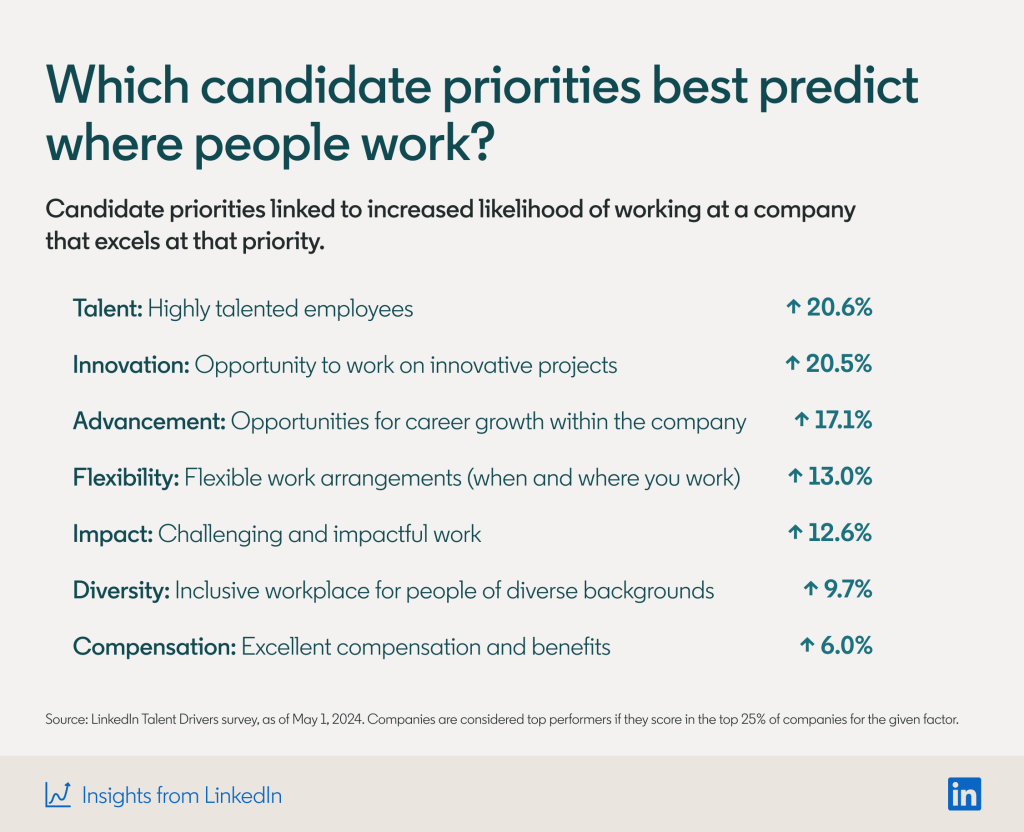
  • Highly Talented Employees: Only 11% of members prioritise this, yet those who do are over 20% more likely to work at companies known for having highly talented employees.
  • Innovative Projects: Members who prioritize innovation are also over 20% more likely to work at companies recognized for innovation.
  • Opportunities to Advance: Gen Z candidates, in particular, value career advancement opportunities, and those who prioritize this are 17% more likely to work at companies offering clear paths to advancement.
  • Flexible Work Arrangements: Flexibility is a critical factor, with candidates prioritizing this being 13% more likely to work at companies known for flexibility.
  • Challenging and Impactful Work: Baby Boomers value this highly, and those who prioritize challenging work are 13% more likely to work at companies offering it.
  • Inclusive Workplace: Diversity may not be a top priority for many, but those who value it are 10% more likely to work at companies known for inclusion.
  • Compensation: Despite being the most common priority, those who prioritize compensation are only slightly (6%) more likely to work at top-paying companies, suggesting other factors are also influential.

Misalignments Between Stated and Revealed Preferences

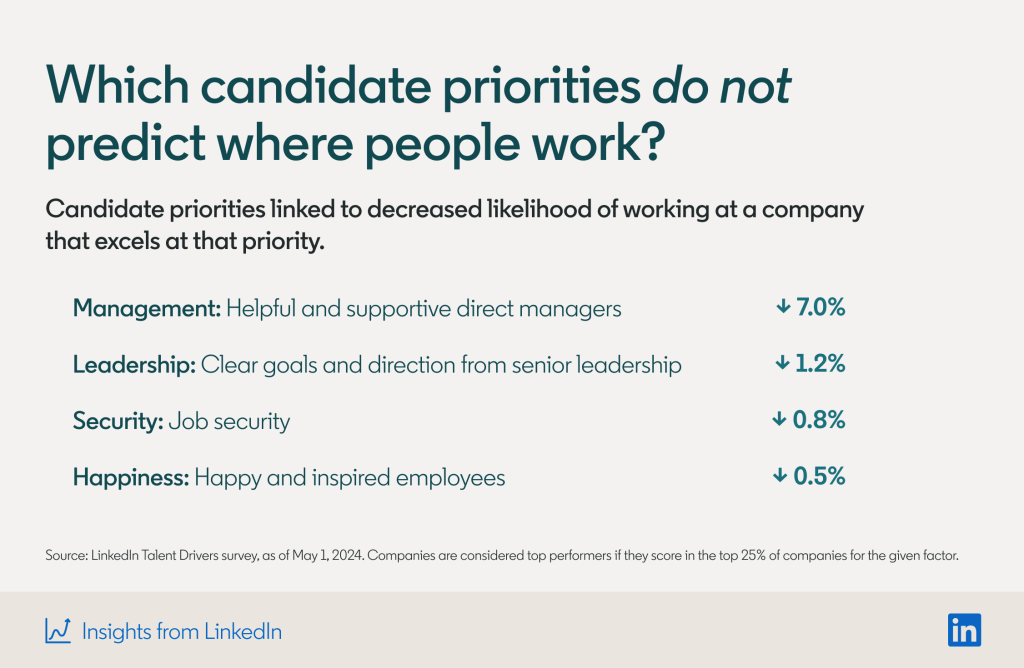
Negative Correlations: Some stated preferences do not align with where people end up working. For example:

  • Helpful Managers: Members who prioritize helpful managers are 7% less likely to work at companies known for good management, possibly due to the difficulty of assessing management quality during the hiring process.
  • Clear Leadership, Job Security, and Inspired Employees: These factors show a weaker correlation with actual job choices, indicating they may be less decisive in candidates’ career decisions.

Implications for Employer Branding

Strategic Alignment: By understanding and leveraging revealed preferences, companies can more effectively tailor their employer branding strategies. This approach ensures that branding efforts resonate with what truly matters to potential candidates, thus enhancing the ability to attract and retain top talent.

Actionable Insights:

  1. Highlight Flexibility: Emphasize flexible work arrangements in branding efforts.
  2. Showcase Innovation and Advancement Opportunities: Promote opportunities for innovation and career growth.
  3. Focus on Impactful Work and Inclusion: Highlight the challenging and inclusive nature of the work environment.
  4. Balance Compensation with Other Priorities: While compensation is crucial, ensure other appealing aspects of the workplace are also highlighted.

By focusing on these revealed preferences, companies can create a more compelling and authentic employer brand, ultimately leading to better talent acquisition and retention.

Source: Linkedin Talent Blog

29May

What are the benefits working in the HVAC industry in Australia?

Working in the HVAC (Heating, Ventilation, and Air Conditioning) industry in Australia offers several benefits, including:

  1. Job security and career advancement opportunities: The HVAC industry in Australia is experiencing steady growth, with an expected market value of $3.5 billion by 2025.This growth has created good job security and solid pathways for career advancement within the industry.
  2. High earning potential: To attract and retain qualified workers, HVAC employers in Australia are offering generous compensation packages. The industry is known for providing competitive salaries, often out earning those who pursue typical university paths.
  3. Diverse job roles: The HVAC industry offers a variety of job roles, including technicians, site managers, project managers, and apprenticeships. This diversity allows for career growth and specialization within the field.
  4. Opportunities for apprenticeships: Many HVAC businesses in Australia are actively seeking new apprentices or mature apprentices, providing the opportunity to earn while learning and securing full-time employment upon completion.
  5. Technological advancements: The HVAC industry is embracing technological innovations, such as building automation systems, smart thermostats, and energy management software. This allows HVAC professionals to work with cutting-edge technologies and develop new skills.
  6. Focus on sustainability: With the increasing emphasis on energy efficiency and sustainability, the HVAC industry is addressing eco-conscious considerations like solar compatibility, sustainable design strategies, and meeting government energy targets. This aligns with broader environmental goals and provides opportunities for professionals to contribute to sustainable solutions.
  7. Variety of work environments: HVAC professionals can find employment in various sectors, including residential, commercial, industrial, and specialized fields like healthcare, aged care, and education facilities.

Overall, the HVAC industry in Australia offers promising career prospects, competitive compensation, opportunities for skill development, and the ability to work in a field that contributes to energy efficiency and sustainable practices.

Trends and benefits in the HVAC Industry

The HVAC (Heating, Ventilation, and Air Conditioning) industry in Australia is experiencing several notable trends and benefits, driven by factors such as energy efficiency, sustainability, and technological advancements. Here are some key points:

Energy Efficiency and Sustainability

  1. Increased adoption of energy-efficient HVAC systems: There is a growing demand for energy-efficient cooling and heating solutions, such as high-efficiency heat pumps, variable refrigerant flow (VRF) systems, and smart HVAC controls, to reduce energy consumption and carbon emissions.
  2. Integration of sustainable energy systems: Incorporating HVAC systems with geothermal or solar energy eliminates the need for fossil fuels or electricity, reducing operational costs and carbon footprint.
  3. Green construction designs: Sustainable building designs with optimized airflow, proper ventilation, and insulating materials enhance the efficiency and lifespan of HVAC systems.

Technological Advancements

  1. Computer-controlled systems: Intelligent computer-controlled systems automate ventilation, address indoor air pollutants, and maintain indoor air quality, providing detailed assessment reports for efficient maintenance.
  2. Building automation systems: Integration of sensors, energy management software, and smart thermostats enables remote control, monitoring, and optimization of HVAC systems for improved performance and energy savings.
  3. Advanced rooftop packaged air conditioners: Incorporating features like variable speed fans, inverter controls, and economizers can reduce energy consumption by about 17%.

Indoor Air Quality and Health

  1. Increased emphasis on indoor air quality (IAQ): Growing awareness of health implications has led to a greater demand for HVAC systems with advanced filtration, air disinfection technologies, and effective ventilation to improve indoor air quality.
  2. Mitigating airborne contaminants: Ventilation systems play a crucial role in reducing the spread of airborne diseases and contaminants, contributing to better indoor air quality.

These trends and benefits highlight the HVAC industry’s focus on energy efficiency, sustainability, technological innovations, and improving indoor air quality, aligning with Australia’s goals of reducing carbon emissions and promoting healthy living environments.

If you are currently looking for work in this industry and have the relevant qualifications and experience please contact us via our contact page. Employers are welcomed to get in touch if you require quality skilled staff, At CALACASH, we are committed to connecting businesses with the best HVAC professionals in the industry. Our dedicated team, extensive network, and customised recruitment solutions ensure that your business can thrive with skilled HVAC technicians. Contact us today to learn more about how we can help you find the right candidates for your HVAC needs.

27May

8 Ways to Show You Want the Job

So, you’ve reached the interview stage. Now how do you show that you really want the job?

No matter what stage you’re at in your career, it’s exciting and maybe even a little nerve-wracking to get to the interview stage for a role. Often, there can be a lot riding on the result. You could be trying to fulfill a lifelong aspiration, or it offers benefits that align really well with where you’re at right now with your life, or what you want your future to look like.

But you’re often not the only applicant for a role or the only person that they are going to be interviewing, so how do you show the interviewers that you’re not only the right person for the role but that you want it more than the others?

Demonstrate Self-Motivation

It’s all well and good to say you really want the job, but it can help you stand out if you can back it up with tangible reasons that demonstrate this. If you can prove your drive to be successful in the specific sector or role that you’re applying for, this can help the interviewers see that your enthusiasm goes beyond ‘just landing the job.’ Knowing the job description inside out and conveying knowledge of the sector that goes beyond what’s in the job ad can help.

Research and Share Knowledge

Before the interview, research as much as you can, not only about the company but the role itself and everything that it entails such as responsibilities, main objectives, long-term goals, and ways this role would typically help the company improve. You also need to research the industry that the business operates in – any deeper background knowledge of the sector will show that you’ve taken the initiative to learn and prove that you’re enthusiastic to be a part of it.

Go the Extra Mile

But before you get to the interview stage, there are things that can be done to show you really want the job at the initial application phase. While it’s time-consuming, if you’re really keen on a role, it can pay to go the extra mile. When writing your application, include a section after your cover letter to answer any specific criteria that the organization may have put on the job description. If they list things like experience in a similar role, good communication skills, experience working with external stakeholders, answer these directly so the hiring manager can immediately see these and define whether you might be a good fit. Taking this extra step can make it easier for the hiring manager and will leave an impression. If you’re going for something like a marketing or design role, provide links to past examples of your work, especially those that align directly with the job you’re applying for, which shows you’ve put thought into the application and that you’re a potential fit.

What You Can Contribute

Especially in the case of mid to senior-level roles, have key points prepared to deliver on how you can contribute to the company’s continued success. Relay how you think the organization could continue to evolve and how you can help with that by bringing up results and success in your previous work – ensure to include hard insights backed up by data and statistics to help support this.

Display Your Suitability Throughout

During the interview process, ensure you’re constantly reiterating your suitability for the role. It’s good to compliment a few of your answers with a demonstration of how your skills and experience apply to that particular line of questioning. For instance, “Tell me about your prior work experience,” can be answered by providing not only your work history at a surface level but how what you learned in those roles can apply directly to the role you’re going for and how the continued growth you can experience in this job makes you excited about the opportunity.

Why Do You Want This Job?

All of this leads into what is quite a common interview question. Why? Why do you want to work with us? Why do you want this role? Yes, a common question, but it can be challenging on the spot if you haven’t researched beforehand. Think of this as your final pitch for the job. A great method for structuring an answer to this interview question is thinking about how your prior skills apply to the role, how that would help, how you would be able to grow those skills in the role and why this business and industry is the one you want to grow in.

Let’s give an example:

I think this is the right role for me as I’m eager to move into an organization that aligns with my values and allows me to execute work that I’m passionate about. I have a defined skill set that I think would aid me greatly in this position and allow me to hit the ground running, but I also appreciate that I have room to grow in this role and that potential for evolution greatly excites me.

We’ve left out some specific details that you can fill in, like your skills for instance, but you get the idea.

Be Enthusiastic and Positive

Enthusiasm is contagious, and showing genuine excitement about the role and the company can make a lasting impression. Speak positively about the opportunity and convey your eagerness to join the team. Smile, maintain good eye contact, and use an energetic tone. This enthusiasm can demonstrate that you are passionate about the role and eager to contribute to the company’s success.

What You Shouldn’t Say in an Interview

If you’re keen on a particular role, there are a few things you should avoid mentioning, such as the salary or benefits being a key reason that you want the job. While these elements can be contributing factors to you applying for the role in the first place, don’t define them as the main reasons in the interview. Focus on how you’re passionate about the company, excited to work in the industry, and how your skills can benefit the company. Also, it’s important to remember, while you need to be confident in your abilities, adopt a humble attitude. Remember to also avoid listing off things that may already be on your resume or listed criteria, although it’s important to be able to talk through it if needed.

24May

Elevate Your Career with Opportunities That Reward Your Skills

Are you sick of your current job and ready for a change? Feeling undervalued and deserving of a raise? It’s time for an upgrade! Dive into new horizons where your talents are truly appreciated and rewarded. At CALACASH, we connect ambitious professionals with roles that promise growth and recognition. Whether you seek a significant salary bump, better benefits, or a more fulfilling role, we’re here to help you achieve your career goals. Join us in finding the place where your skills shine the brightest. Your career deserves the spotlight—let’s make it happen!

Understanding Career Growth

Definition and Importance

Career growth refers to the progression of an individual’s professional life, characterised by increased responsibilities, higher positions, and improved remuneration. It is crucial for personal fulfillment and professional satisfaction, driving individuals to reach their full potential.

Career Growth vs. Job Satisfaction

While job satisfaction relates to the contentment one feels in their current position, career growth involves a broader perspective, focusing on long-term achievements and advancements. Balancing both is essential for a fulfilling professional life.

Why You Should Consider a Career Change

Signs It’s Time for a Change

Feeling stagnant, unchallenged, or undervalued are significant indicators that it might be time to move on. If your job no longer excites or inspires you, a career change could reignite your passion and motivation.

Benefits of a New Job

A new job can offer a fresh start, better salary, improved benefits, and a more stimulating environment. It opens doors to new experiences, professional networks, and opportunities for personal and career growth.

Assessing Your Current Job

Identifying Dissatisfaction

Reflect on your job satisfaction levels. Are you frequently frustrated or demotivated? Identifying these feelings is the first step toward understanding your need for change.

Evaluating Current Benefits

List the benefits your current job provides. Compare them with industry standards and your personal needs to see if there are gaps that a new job could fill.

Recognising Your Value

Acknowledge your skills and contributions. Understand your worth in the job market to better negotiate for roles that match your potential.

Steps to Elevate Your Career

Self-Assessment

Evaluate your strengths, weaknesses, and career aspirations. Understanding yourself is crucial for setting realistic and achievable career goals.

Goal Setting

Define clear, actionable goals. Short-term objectives help maintain focus, while long-term goals provide direction and motivation.

Skill Development

Identify the skills necessary for your desired roles and work on enhancing them. Continuous learning and improvement are vital for career advancement.

The Role of Skills in Career Advancement

Importance of Skill Enhancement

In today’s competitive job market, continuously updating your skills is essential. It not only keeps you relevant but also opens doors to better opportunities.

Identifying Key Skills

Focus on both hard skills (technical abilities) and soft skills (communication, leadership). Both are equally important in career progression.

CALACASH: Who We Are

Overview

CALACASH is dedicated to connecting professionals with roles that match their skills and aspirations. Our extensive network and industry expertise make us a reliable partner in your career journey.

Mission

Our mission is to empower individuals by providing opportunities that recognise and reward their talents, fostering professional and personal growth.

Services

We offer personalised job matching, career counselling, and access to a wide range of job opportunities across various industries.

How CALACASH Can Help You

Personalised Job Matching

We understand your unique skills and career goals, matching you with roles that fit your profile perfectly.

Career Counseling

Our experts provide guidance on career planning, resume building, and interview preparation to ensure you present your best self.

Network of Opportunities

With a broad network of employers, we offer access to diverse and rewarding job opportunities.

Identifying Opportunities That Reward Skills

Types of Roles

Explore roles that require and reward your specific skills. Positions in technology, healthcare, finance, and education often seek skilled professionals.

Sectors with High Demand

Industries such as IT, healthcare, and renewable energy are booming and constantly in search of skilled workers.

Companies That Value Skills

Research companies known for valuing employee skills and contributions. These organizations often provide better growth opportunities and job satisfaction.

Preparing for a Career Transition

Evaluating Job Offers

Looking into Company Culture and Work-Life Balance

When evaluating job offers, it’s crucial to consider the company’s culture and work-life balance. A positive company culture fosters a supportive and inclusive environment where employees feel valued and motivated. Look for companies that prioritize employee well-being, offer flexible working hours, and promote a healthy work-life balance. Understanding the company’s values, mission, and day-to-day work environment can help ensure that your new job will support your professional growth and personal well-being, leading to greater job satisfaction and long-term career success.

Identifying Opportunities That Reward Skills

Labour Hire or Permanent Positions: Expertise Across Industries

When searching for new opportunities, consider whether you’re looking for labour hire or permanent positions. Labour hire roles offer flexibility and the chance to gain experience across different companies and industries, while permanent positions provide job stability and long-term career growth. At CALACASH, we specialize in both areas, connecting skilled professionals with roles in various sectors such as construction, healthcare, logistics, and information technology. Our extensive industry expertise and tailored job matching services ensure that you find a position that not only matches your skills but also aligns with your career aspirations and lifestyle preferences.

Updating Your Resume

Ensure your resume highlights your most relevant skills and experiences. Tailor it to match the job descriptions of the roles you are applying for.

Building a Personal Brand

Establish a professional online presence through platforms like LinkedIn. Share your achievements, expertise, and insights to attract potential employers.

Networking Strategies

Attend industry events, join professional groups, and connect with peers to expand your network. Networking can lead to job opportunities and valuable professional relationships.

How to Identify Your Key Skills

Self-Assessment Tools

Use online tools and assessments to identify your strengths and areas for improvement. These insights can guide your career decisions.

Feedback from Peers

Seek feedback from colleagues and mentors. Their perspectives can help you understand your skills better and identify areas to develop.

Professional Assessments

Consider professional evaluations and certifications to validate your skills. These can enhance your credibility in the job market.

Maximizing Your Current Role

Seeking Internal Opportunities

Look for opportunities within your current organization to advance your career. Internal promotions can provide growth without the need for a complete job change.

Negotiating a Raise

Prepare a case highlighting your contributions and market research to negotiate a raise. Demonstrating your value can lead to better compensation.

Skill Application in Current Job

Apply your skills to take on new challenges and projects. This not only adds value to your role but also enhances your resume.

The Importance of Networking

Building Professional Relationships

Cultivate relationships with industry professionals. Networking can provide support, advice, and job leads.

Leveraging Networks for Job Opportunities

Use your network to learn about job openings and get referrals. Personal connections can often open doors that would otherwise remain closed.

Navigating Job Interviews

Preparing for Interviews

Research the company and role thoroughly. Practice common interview questions and prepare to discuss your skills and experiences confidently.

Common Questions

Be ready to answer questions about your background, skills, and why you’re interested in the role. Highlight your achievements and how they align with the job requirements.

21May

Industries hiring now and roles where job ads are rising

Interest among job-seekers in finding new roles continues to grow, with applications rising across nearly every industry. If you want to narrow your job search, it’s essential to explore where the opportunities lie.

Are you considering a job change? You’re in good company. Research from SEEK shows that 40% of candidates are looking to switch jobs in the next six months. For 37% of these individuals, the primary motivation is seeking a new challenge, while 34% desire a fresh start. Whether you’re in search of a new challenge or a fresh beginning, it might be the perfect time for a change.

Job ads saw a 4.7% decrease month-on-month in April, likely due to the Easter and Anzac Day public holidays. However, job ad volumes have been fluctuating with both increases and decreases month-to-month since the start of the year.

Applications per job ad, which have been steadily increasing for over 18 months, surged by 8.6% in March and have grown by 70.9% over the past year. By investigating the most in-demand industries and job roles, you can uncover potential opportunities and gain valuable insights to guide your job search effectively.

Source (SEEK)

Source (SEEK)

Information & Communication Technology: A Booming Industry

The Information & Communication Technology (ICT) industry has experienced the highest growth in job ads over the past seven weeks, with an increase of 15.2%.

Education & Training: A Thriving Sector

The Education & Training industry has also shown significant growth in job ads, increasing by 8.8% over the last seven weeks.

If you’re contemplating your next career move, don’t hesitate to delve into the latest trends in job ads and industry shifts. Your next great opportunity could be just around the corner.

(Data and Stats sourced from SEEK)

17May

Hidden Costs – What is DIY Recruitment Really Costing You, Part Two.

In part one (and if you want to have a read, click here!), we talked about some of the hidden costs in recruiting internally.  It can seem like a really good idea – after all, you have control, and control is good, no uncertainty, what could be better?

Well – quite a lot could be quite a lot better!

We have detailed the internal time and effort it can take to interview – and remember, that is not just one person!  When you get to the later rounds of an interview process, you are taking the time and effort of some pretty senior people, most likely on some pretty significant salaries.  But this post isn’t about the internal cost.

Instead, today, I want to talk about the Jerry Maguire effect.

Imagine, in this instance, that you have a strong salesperson, in a reasonably strong sales area, resign.  Now, that’s a shame – and you have the significant risk that the customers who have a relationship with that salesperson will leave, too!  But after all the tears, and the farewell party, and the cringeworthy speeches, the time comes to fill that role.

We have established that doing this internally means taking time – time out of your day, time out of others’ days, time away from your core role or other responsibilities.  But what else does choosing to do this internally mean?

It means…as ever…that time marches on.

Every day that role is unfilled, is a day of potential revenue that may be missing – that’s money coming in to grow the business.  That could be from existing business – although you may be able to handle some of that, perhaps not as well, with your current resources.  But that is also new business – clients you don’t have yet.  And if you aren’t winning that business, your competition is.  Just hold that in your mind for a moment – when you’re not selling, your competition must be.  Not only do you lose, but your competition wins – it’s a double whammy.

Now, back to time.

If it takes six weeks to advertise, vet the CVs, phone screen, first round interview, final interview, and reference check – which for an internal process is about right – that is almost 12% of the year before a new sales person is even close to starting.  Now, let’s assume the new starter has a four week notice period, which is pretty standard.  We’re up to ten weeks – almost 20% of the year.

What happens when a new starter joins a business? They go through induction, they meet the teams, they go through training – let’s assume another two weeks at least, up to twelve weeks now – and they take the time to build up and ramp up their activity – let’s say another four weeks, so sixteen weeks – we see the kind of timeframe before they even begin to produce. 

Getting up to that full level of production in sales can take up to 5 months in some industries (source).  Bearing in mind that annual attrition rates in sales roles are about 36% (source) – and one in ten organisations experience a sales staff churn rate of 56% (source) – what does all of this mean to your revenue?

If you are in that last bracket, that means that even after the ten weeks to recruit, and the further six weeks of training and onboarding and initial activity (all of which, remember, takes your time, and time is money) – even after all of that missed revenue, you have a better than one in three chance that you’ll go back to the drawing board!  So that 16 weeks31% of the year – resets.

That is just for the sales role, of course – but the lost revenue opportunity exists in many roles, and the loss in productivity is still a productivity your competitor are likely to take advantage of.

Relying on your own internal resources, without leaning on an expert who can help you place a role with candidates that are high quality, who aren’t actively applying for roles and therefore who you never see, and without the speed to fill that a dedicated recruitment partner can bring…it’s another version of the definition of insanity.  If we keep doing the same thing – why would the result ever be different?

16May

Best questions to ask at the end of an interview.

Best answers to the interview question “would you like to ask any questions?”

When given the opportunity to ask questions at the end of a job interview, it’s crucial to ask thoughtful, insightful questions that demonstrate your genuine interest in the role and the company. Here are some great questions to consider:

Questions About the Role

  1. Can you describe a typical day or week in this role?
    • This question helps you understand the day-to-day responsibilities and expectations, providing a clearer picture of what your routine might look like.
  2. What are the biggest challenges someone in this position faces?
    • Knowing the challenges helps you prepare mentally for the role and demonstrates your willingness to tackle obstacles head-on.
  3. What skills or attributes make someone successful in this job?
    • This question can provide insight into the key competencies and behaviors valued by the company, allowing you to highlight your relevant strengths.
  4. What are the opportunities for growth and advancement in this role?
    • Understanding the potential for career development within the company can help you gauge long-term fit and alignment with your career goals.

Questions About the Company

  1. What’s the company culture like? How would you describe it?
    • This question gives you a sense of the company’s values, work environment, and whether it aligns with your preferences and working style.
  2. What gets you (the interviewer) most excited about the company’s future?
    • This shows your interest in the company’s trajectory and can reveal the interviewer’s personal enthusiasm and insights about the company’s direction.
  3. How does this role contribute to the company’s larger goals or mission?
    • Understanding how your role fits into the broader mission helps you see the impact of your work and aligns your efforts with the company’s objectives.
  4. What are the company’s major priorities or initiatives right now?
    • This question provides context on the company’s current focus and strategic plans, helping you understand the environment you’ll be working in.

Questions for Your Interviewer

  1. Why did you decide to join the company? What keeps you motivated?
    • This personal question can provide insight into the company’s strengths and culture from someone who experiences it firsthand.
  2. What do you like most about working here? What are some challenges?
    • Learning about the positives and the challenges gives you a balanced view of what to expect and helps you gauge overall employee satisfaction.
  3. How would you describe the working relationship with the team I’d be joining?
    • Understanding team dynamics is crucial for anticipating how you might fit in and collaborate with your future colleagues.
  4. Is there anything else I should know about the role or company?
    • This open-ended question allows the interviewer to share any additional information they think is important for you to know, ensuring you have a comprehensive understanding.

Key Points to Remember

  • Ask Insightful Questions: Show your genuine interest in the role and company.
  • Avoid Yes/No Questions: These don’t provide much information and can make the conversation feel stilted.
  • Stay Professional: Avoid anything too personal or sensitive.
  • Be Open-Ended: Allow the interviewer to provide more context and detailed answers.

Asking well-thought-out questions not only provides you with valuable information but also leaves a positive impression on the interviewer, showcasing your enthusiasm and readiness for the role.

09May

Trending Jobs in Manufacturing in 2024: Skills, Demand, and Opportunities

Wondering what the best manufacturing jobs are in 2024?

Discover the most in-demand manufacturing jobs in 2024, explore essential skills, and learn about the impact of technology and sustainability on the sector. Find out how you can prepare for a future in manufacturing today.

Introduction

In 2024, the manufacturing sector continues to evolve rapidly, driven by technological advancements and a global shift towards sustainability. Despite concerns about automation, there is a robust demand for skilled and semi-skilled workers. This article explores the trending jobs within the industry, highlighting the skills and certifications needed to thrive, the educational paths available, and the impact of new technologies on these roles.

Impact of Automation and Digital Skills

The Reality of Robots and Automation

While automation has replaced some tasks, it has also created new roles and opportunities for skilled workers who can manage and maintain these technologies.

Essential Digital Skills for Modern Manufacturing

Digital literacy is no longer optional. Today’s manufacturing workers need to be adept at using digital tools that enhance productivity and decision-making.

Australia’s Manufacturing Landscape

Dependency on Global Supply Chains

Recent global events have underscored the vulnerability of long supply chains, prompting a push towards more resilient local manufacturing ecosystems in Australia.

Opportunities in Local Manufacturing

This shift is expected to boost job creation significantly, offering numerous opportunities for skilled workers within the country.

Educational Pathways

Vocational and On-the-Job Training

Formal degrees are less common in manufacturing, with emphasis placed on practical, vocational training and certifications that provide direct skills applicable in the workplace.

Key Jobs and Roles in Manufacturing

Pick Packers

Role and Responsibilities

Pick packers are crucial in the logistics chain, handling the accurate picking and packing of goods for shipment. The rise of online shopping has spiked demand for these positions.

Path to Advancement

Starting typically on a part-time or casual basis, diligent workers often quickly ascend to supervisory or managerial roles due to the fast-paced nature of the work.

In demand skills and qualifications for pick packers.
  • task and duties
    • Receiving stock, selecting and preparing goods for dispatch, loading and unloading trucks.
    • General warehousing duties, machine operation, cleaning, administration.
    • Complying with occupational health and safety guidelines.
  • skills
    • Reliability and time-keeping
    • Teamwork
    • Ability to think on your feet
    • Problem-solving
  • training and qualifications
    • No formal qualifications are required as training will be provided.
    • But experience in similar roles can be helpful.

Production Workers

Specialisation and Skills

Gone are the days of monotonous assembly lines; modern production workers are highly specialised, operating complex machinery and ensuring quality control.

Automation and Training

As automation becomes commonplace, workers are required to upskill, making versatility a highly prized attribute.

In-demand skills and qualifications for production workers.
  • tasks and duties
    • Preparing and operating machines and power tools. 
    • Recording production data and checking output for quality.
    • Quality assessment and control.
  • training and qualifications
    • No formal qualifications are required as training will be provided. But experience in similar roles can be helpful.
    • You may be required to hold specific licences or accreditation.

Process Workers

Keeping Machines Running

Process workers maintain the smooth operation of manufacturing machinery, ensuring production deadlines are met and quality standards are maintained.

Opportunities for Growth

With no previous experience required, these roles offer significant on-the-job training, allowing workers to gain valuable skills while earning.

In-demand skills and qualifications for process workers.
  • tasks and duties
    • Preparing and maintaining production reports and records.
    • Maintaining equipment and coordinating services when required.
    • Maintaining a high standard of safety in the workplace.
    • Following set production schedules.
    • Reporting faults or production issues to the manager.
  • training and qualifications
    • Most manufacturing companies hire process workers at an entry-level with no previous work experience.
    • Therefore, you have a chance to develop your technical abilities, time management, and problem-solving skills. This will help you improve your work experience.

Impact of New Technologies

Sustainable Production Techniques

The manufacturing sector is increasingly adopting sustainable and eco-friendly production methods, which not only reduce environmental impact but also open up new job roles focused on green technologies.

Impact of Net Zero Goals

Decarbonisation and Manufacturing

The drive towards net zero emissions is reshaping manufacturing, with a focus on reducing the carbon footprint of production processes and end products.

Local Production Benefits

Shorter, more sustainable supply chains are not just environmentally beneficial but also economically advantageous, supporting local economies and job markets.

Final Thoughts

The manufacturing sector in 2024 offers a vibrant array of career opportunities that are both economically vital and personally rewarding. With the right training and a willingness to adapt to new technologies, individuals can find stable and fulfilling careers in this ever-evolving industry.

09May

Benefits of Working in the Transport and Logistics Industry in Australia in 2024

Explore the key benefits of pursuing a career in Australia’s booming transport and logistics industry in 2024, from job security to diverse career paths and flexible work arrangements.

Introduction

The transport and logistics industry is integral to the sustenance and growth of any economy, and Australia is no exception. In 2024, this sector not only drives the physical movement of goods but also offers robust employment opportunities. This article delves into the significant advantages of working within this dynamic field in Australia, highlighting aspects such as job security, career diversity, flexibility, and personal fulfillment.

Job Security and Growth Opportunities

Overview of the Industry’s Economic Impact

The transport and logistics sector in Australia boasts a remarkable annual revenue of $101.51 billion, underscoring its critical role in the nation’s economy. Employing over 500,000 people, the industry not only supports a vast workforce but also promises continued growth and stability.

Career Advancement and Progression

In an era where job security is increasingly precarious, the transport and logistics industry stands out as a beacon of stability. Employees benefit from numerous upward mobility opportunities, facilitated by the sector’s expansion and the essential nature of its services.

Diverse and Rewarding Career Paths

Range of Careers in Transport and Logistics

From piloting aircraft to managing warehouses, the industry offers a plethora of roles that cater to various interests and skills. This diversity not only enhances job satisfaction but also aids in the holistic development of professionals.

Skill Development and Transferability

Working in this sector allows for the cultivation of critical skills such as problem-solving, effective communication, and strategic planning. These capabilities are highly transferable and valued across other industries, making employees versatile and adaptable.

Flexible Work Arrangements

Non-Traditional Work Schedules

The necessity for 24/7 operations translates into flexible scheduling for employees, including options for night shifts, weekends, and non-standard hours. This flexibility is particularly appealing to those who seek a work-life balance tailored to their personal circumstances.

Benefits of Shift Work

Besides offering flexibility, unconventional work hours can also lead to better pay and more personal time during traditional workdays, providing a unique advantage over regular 9-to-5 jobs.

Job Fulfillment

Impact on the Economy and Daily Life

Employees in the transport and logistics industry often express a high degree of job fulfillment. The direct impact of their work on the economy and the daily lives of people adds a meaningful dimension to their professional lives.

Personal Satisfaction

Knowing that their work ensures the smooth functioning of societal infrastructures and contributes to national growth brings a significant sense of pride and accomplishment to workers in this field.

Opportunities for Upskilling and Career Progression

Embracing New Technologies

The rapid integration of technologies like AI, automation, and data analytics into logistics offers workers the chance to stay ahead in the job market by continually upgrading their tech skills.

Training and Development Programs

Investments in employee development are prominent in this industry, with numerous training programs designed to enhance both the hard and soft skills of the workforce. This not only boosts individual career prospects but also the overall competency of the industry.

Final Thoughts

The transport and logistics industry in Australia provides not just a job but a promising career path characterised by security, diversity, flexibility, and personal satisfaction. As the industry continues to grow and evolve, it remains a critical component of the nation’s infrastructure and an attractive option for job seekers in 2024.